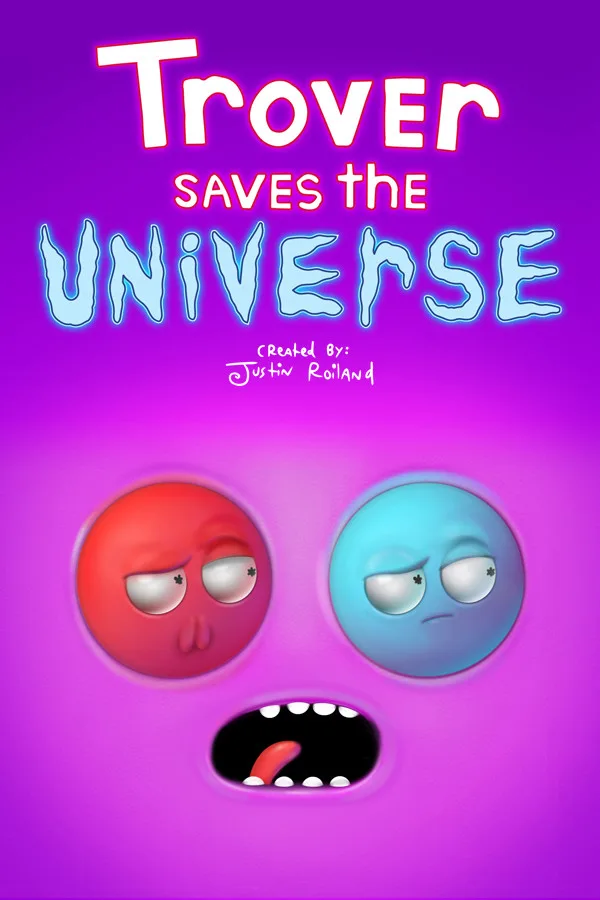
Trover Saves the Universe
MAKE — TROVER SAVES THE UNIVERSE
A self-directed port team took a PlayStation VR comedy adventure to Xbox One and Nintendo Switch — and delivered five months ahead of schedule.
Partner studio: Puny Human
Concept
A comedy action-adventure played from the perspective of a seated “chairorpian,” directing the title character through a bizarre, densely voiced universe. Originally built for PlayStation 4 and PlayStation VR with a high-fidelity art package, later extended with free downloadable content.
Requirement
Following a well-received PlayStation and PC launch, the partner wanted the title on Nintendo Switch and Xbox One, packaged with the free DLC. Switch was the binding constraint: the game was simply too large to transfer directly without modification, and reducing it had to be done without visibly compromising the artistic vision. Xbox One brought its own problems, including account-swap and save-data failures that returned players to the main menu or crashed the game. The partner retained marketing, store management, localization and art, and needed the port team to run itself.
Approach
A dedicated team of engineers, QA testers and producers operated separately from the client's development team for the first time — the client set deadlines, the team managed the path to them. Engineers split across the two platforms and defined their own code review process.
Optimization was approached as a data problem. Pre-programmed agents built on the Gauntlet automation tool ran continuous performance capture, including agents that warped repeatedly around the game to gather metrics unattended. Texture and lighting audits identified assets carrying unnecessary high-resolution textures or dynamic lighting in places players would never notice, so reductions could be targeted where they would not be seen.
Custom code was written for account and user management to resolve the Xbox One save and profile failures. The underlying Unreal Engine 4 version was upgraded several times mid-project; every resulting defect was regression-tested across platforms and against the shipped build, with automation absorbing the routine load so testers could concentrate on engine-upgrade regressions.
Delivery scope
- Gameplay and systems programming
- Hardware porting (Nintendo Switch, Xbox One, PC)
- Game and render performance optimization
- Custom account and user management systems
- Test automation (Gauntlet)
- Quality assurance
- Texture and lighting audits
- Unreal Engine version upgrades
- Build engineering, DevOps and cloud engineering
- Platform certification
- Production and client liaison
Results
- Nintendo Switch released 28 November 2019 and Xbox One 3 December 2019, both packaged with the free DLC
- Port delivered five months ahead of schedule
- Stable 60 fps achieved on Xbox One; consistent 30 fps on Nintendo Switch
- 8-person port team over approximately four months, preceded by a separate build engineering engagement (February–April 2019)
- 32–40 person-months delivered
- Client COO: “instrumental in getting Trover Saves the Universe out on-time for PC, Xbox, and Switch”
- Client Senior Producer: “helped deliver our ports earlier than the original timeframe”
- Title nominated for Best VR/AR Game at The Game Awards 2019 and Immersive Reality Game of the Year at the 23rd D.I.C.E. Awards
- Produced the studio's standard operating procedures and platform-onboarding documentation, reused on all subsequent port work
Engine: Unreal Engine 4.
Nintendo Switch released 28 November 2019 and Xbox One 3 December 2019, both packaged with the free DLC
Tell us what the production problem is
Describe the problem and we will scope the smallest useful engagement.